
🎉 Introduction
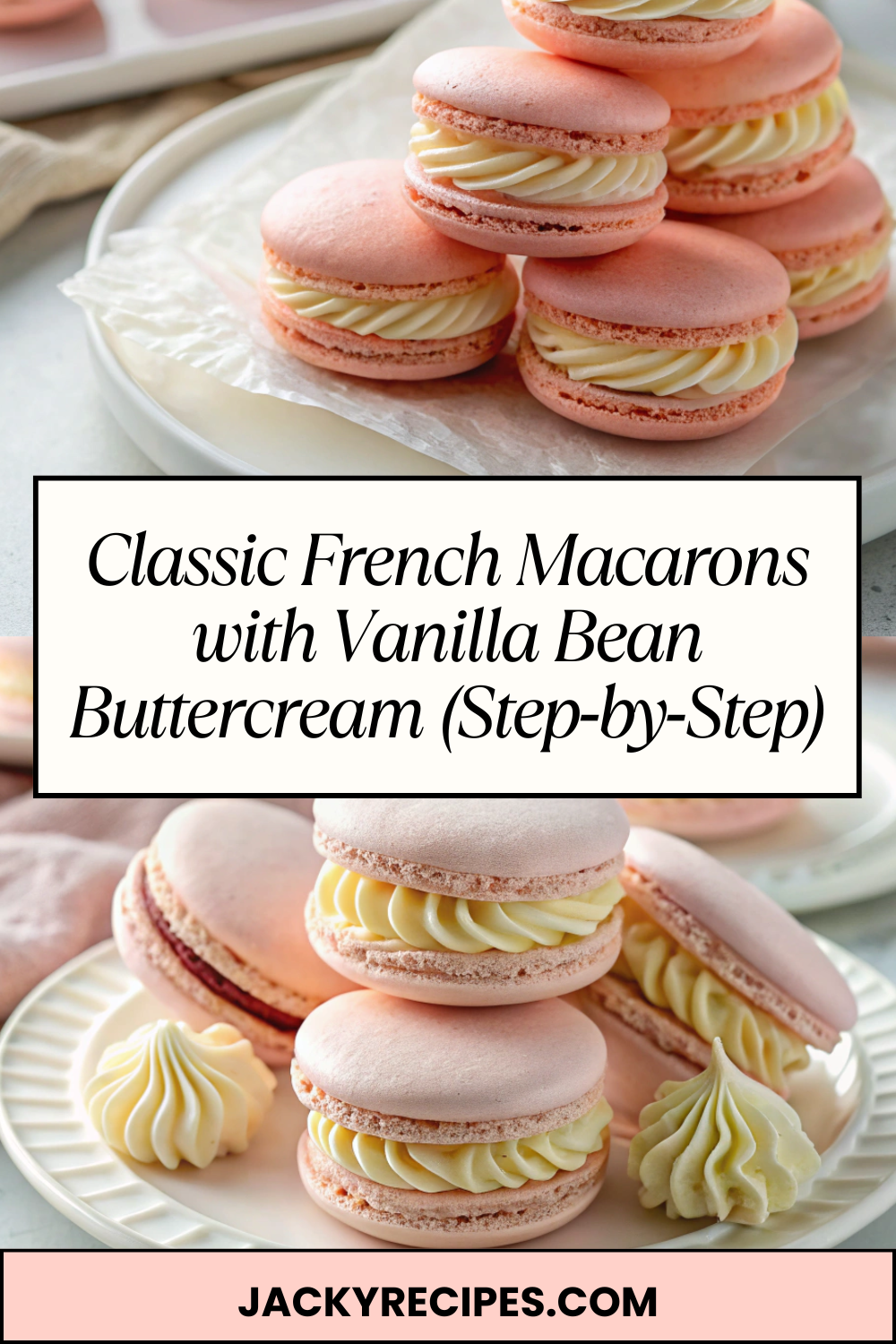
Master crisp, chewy French macarons with smooth, glossy shells and signature ruffled feet. This step-by-step method uses precise weights, simple French meringue, and pro tips for trouble-free baking at home. Fill them with silky vanilla bean buttercream or a firm chocolate ganache for an elegant treat. Perfect for holidays, weddings, or cozy afternoon tea.
🧰 Equipment Needed
- Kitchen scale
- Stand mixer or hand mixer – Whisk attachment for stable meringue
- Fine-mesh sieve
- Food processor – Improves texture; optional if flour is ultra-fine
- Silicone spatula
- Piping bags
- 1/2-inch round piping tip
- 2 rimmed baking sheets
- Silicone baking mats or parchment
- Toothpicks or scribe tool
- Oven thermometer
- Wire cooling rack
🛒 Ingredients
For the Macaron Shells
- 120 grams Superfine almond flour
- 120 grams Powdered (confectioners’) sugar
- 100 grams Egg whites, room temperature
- 100 grams Granulated sugar
- 1/8 teaspoon Cream of tartar
- 1/8 teaspoon Fine sea salt
- 2 to 4 drops Gel food coloring (optional)
For the Vanilla Bean Buttercream
- 115 grams Unsalted butter, softened
- 150 grams Powdered (confectioners’) sugar, sifted
- 1 teaspoon Vanilla bean paste (or pure vanilla extract)
- 1/8 teaspoon Fine sea salt
- 1 to 2 tablespoons Milk (or dairy-free milk), as needed
Optional Chocolate Ganache Filling
- 120 grams Dark chocolate (60–70%), finely chopped
- 80 ml Heavy cream
👩🍳 Directions
Step 1: Prepare Pans and Sift Dry Ingredients
- Line 2 baking sheets with silicone mats or parchment. If desired, place a printable macaron template beneath the parchment for even piping.
- Pulse almond flour and powdered sugar in a food processor 10–12 short bursts, then sift into a bowl. Discard coarse bits; re-sift once more for extra-fine texture.
Step 2: Make the French Meringue
- In a perfectly clean bowl, add egg whites, salt, and cream of tartar. Whisk on medium speed until foamy.
- Gradually rain in granulated sugar while whipping to glossy medium-stiff peaks (softly curled tips that hold when the whisk is lifted). Add gel color now, if using, and mix just to combine.
Step 3: Macaronage (Fold the Batter)
- Sprinkle one-third of the almond-sugar mixture over the meringue and fold with a silicone spatula. Repeat twice more.
- Press and spread the batter against the bowl, then scoop and fold until it flows in a slow ribbon. Perform the figure‑eight test: batter should ribbon continuously and disappear back into itself within 20–30 seconds.
Step 4: Pipe the Shells
- Transfer batter to a piping bag fitted with a 1/2-inch (12–13 mm) round tip.
- Pipe 1.5-inch (3.8 cm) rounds, spacing about 1 inch apart. Tap trays firmly 3–4 times to release bubbles; pop remaining bubbles with a toothpick.
Step 5: Rest and Bake
- Let shells rest 25–45 minutes until dry to the touch with a matte finish.
- Meanwhile, preheat oven to 300°F (150°C).
- Bake one tray at a time for 14–16 minutes, rotating at minute 8. Shells are done when tops no longer wiggle and peel cleanly from the mat once cooled.
- Cool completely on trays before removing.
Step 6: Make Vanilla Bean Buttercream
- Beat butter on medium-high until pale and fluffy, 2 minutes.
- Mix in powdered sugar and salt on low, then increase speed to combine. Add vanilla and enough milk for a smooth, pipeable consistency.
- Transfer to a piping bag fitted with a small round or star tip.
Step 7: Optional Chocolate Ganache
- Heat cream until steaming (not boiling). Pour over chopped chocolate, cover 2 minutes, then stir until glossy and smooth.
- Cool to a thick, pipeable consistency. If too soft, chill briefly; if too firm, warm 5–10 seconds.
Step 8: Fill, Mature, and Serve
- Pair like-sized shells. Pipe a dime-to-nickel sized mound of buttercream (or ganache) on one shell; top with its mate and gently twist to spread to the edges.
- For best texture, place filled macarons in an airtight container and refrigerate 12–24 hours to mature. Bring to room temperature for 15–20 minutes before serving.
Notes
🍽️ Servings & Timing
Yields about 20 sandwich macarons. Prep: 35 minutes; Cook: 30 minutes; Rest before baking: 25–45 minutes; Maturing time: 12–24 hours for best chew.
🧊 Storage & Reheating
Refrigerate filled macarons in an airtight container up to 5 days. Freeze (well-sealed) up to 2 months; thaw overnight in the fridge, then temper at room temperature 15–20 minutes. Do not reheat—serve chilled or at room temperature.
🥄 Variations
Flavor shells with 1–2 teaspoons sifted cocoa or finely milled freeze-dried fruit (reduce powdered sugar slightly). Try matcha shells, lemon zest buttercream, strawberry jam centers, or a dairy-free filling using plant butter and a splash of non-dairy milk.
❓ 10 FAQs
Q1: Why did my shells crack?
Usually under-sifted dry mix, trapped air bubbles, insufficient resting, or an oven that’s too hot. Tap trays well, pop bubbles, and confirm temperature with an oven thermometer.
Q2: How do I fix hollow macarons?
Adjust meringue to medium-stiff peaks, avoid over-folding, and bake a minute or two longer so interiors set fully.
Q3: Do I need to age egg whites?
Not required when weighing precisely, but aging 24–48 hours can make whites whip more predictably.
Q4: Can I make these without a food processor?
Yes—use ultrafine almond flour and sift 2–3 times to remove coarse bits.
Q5: What food coloring works best?
Use gel or powder color; liquid color can thin the batter and affect structure.
Q6: Can I bake two trays at once?
Bake one tray at a time for consistency. With true convection, you may bake two, reducing temperature by about 15°F (10°C).
Q7: Are macarons gluten-free?
They are traditionally made with almond flour, not wheat flour. Always check ingredient labels to be sure.
Q8: How long should I mature them?
Refrigerate 12–24 hours so fillings hydrate the shells for a classic crisp-chewy bite.
Q9: Can I use aquafaba instead of egg whites?
Yes, but it requires a dedicated formula and longer whipping; follow a tested aquafaba macaron recipe for best results.
Q10: My batter spreads too much—what went wrong?
It’s likely over-mixed. Stop folding once ribbons flow slowly and disappear in 20–30 seconds.
🏁 Conclusion
With careful weighing, patient resting, and gentle macaronage, you’ll create bakery-worthy macarons at home—crisp shells, ruffled feet, and a tender chew every time.
Classic French Macarons with Vanilla Bean Buttercream (Step‑by‑Step)
Ingredients
Equipment
Method
- Line 2 baking sheets with silicone mats or parchment. If desired, place a printable macaron template beneath the parchment for even piping.
- Pulse almond flour and powdered sugar in a food processor 10–12 short bursts, then sift into a bowl. Discard coarse bits; re-sift once more for extra-fine texture.
- In a perfectly clean bowl, add egg whites, salt, and cream of tartar. Whisk on medium speed until foamy.
- Gradually rain in granulated sugar while whipping to glossy medium-stiff peaks (softly curled tips that hold when the whisk is lifted). Add gel color now, if using, and mix just to combine.
- Sprinkle one-third of the almond-sugar mixture over the meringue and fold with a silicone spatula. Repeat twice more.
- Press and spread the batter against the bowl, then scoop and fold until it flows in a slow ribbon. Perform the figure‑eight test: batter should ribbon continuously and disappear back into itself within 20–30 seconds.
- Transfer batter to a piping bag fitted with a 1/2-inch (12–13 mm) round tip.
- Pipe 1.5-inch (3.8 cm) rounds, spacing about 1 inch apart. Tap trays firmly 3–4 times to release bubbles; pop remaining bubbles with a toothpick.
- Let shells rest 25–45 minutes until dry to the touch with a matte finish.
- Meanwhile, preheat oven to 300°F (150°C).
- Bake one tray at a time for 14–16 minutes, rotating at minute 8. Shells are done when tops no longer wiggle and peel cleanly from the mat once cooled.
- Cool completely on trays before removing.
- Beat butter on medium-high until pale and fluffy, 2 minutes.
- Mix in powdered sugar and salt on low, then increase speed to combine. Add vanilla and enough milk for a smooth, pipeable consistency.
- Transfer to a piping bag fitted with a small round or star tip.
- Heat cream until steaming (not boiling). Pour over chopped chocolate, cover 2 minutes, then stir until glossy and smooth.
- Cool to a thick, pipeable consistency. If too soft, chill briefly; if too firm, warm 5–10 seconds.
- Pair like-sized shells. Pipe a dime-to-nickel sized mound of buttercream (or ganache) on one shell; top with its mate and gently twist to spread to the edges.
- For best texture, place filled macarons in an airtight container and refrigerate 12–24 hours to mature. Bring to room temperature for 15–20 minutes before serving.



1 thought on “Classic French Macarons with Vanilla Bean Buttercream (Step‑by‑Step)”